


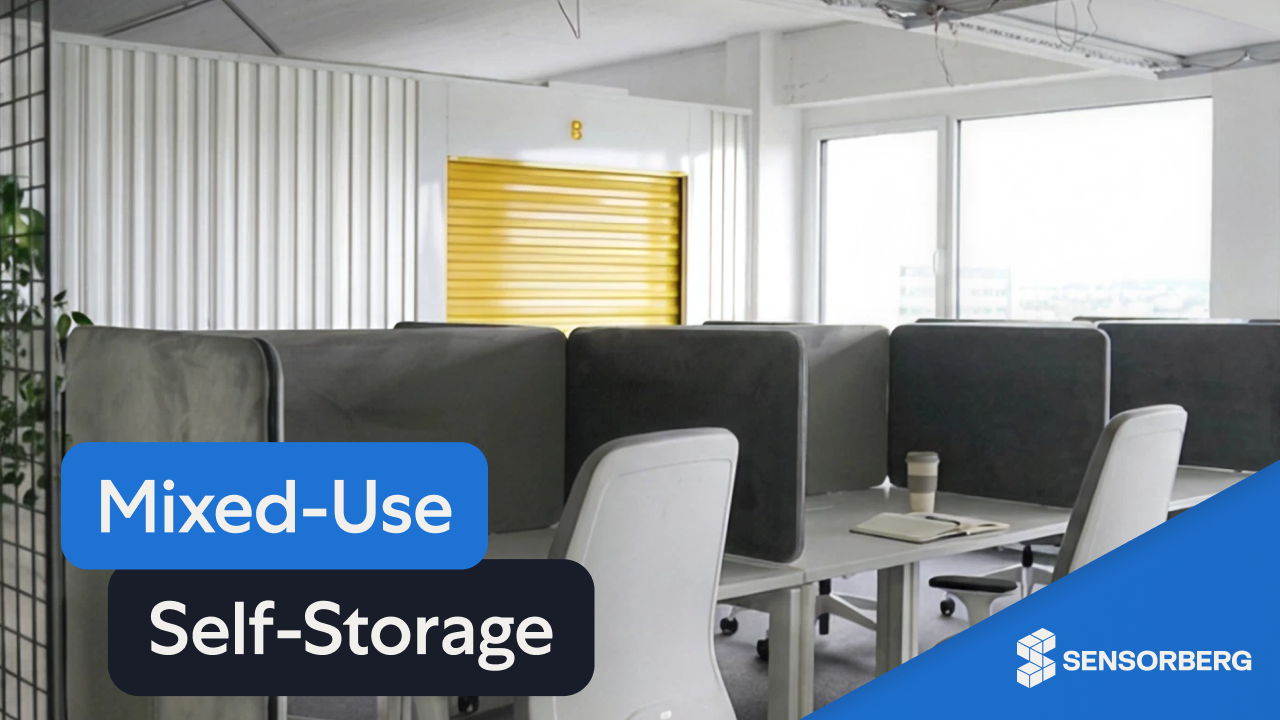
The self-storage facility a few streets from a Berlin startup hub is renting desk space. The one near Amsterdam’s canal district is handling e-commerce parcels for small online sellers. And across the UK, a growing number of operators are discovering that their most valuable customers do not just want a unit — they want an operational base.
Something is shifting in European self-storage. Facilities that once rented little more than secure square metres are increasingly serving freelancers, startups, e-commerce businesses, and SMEs looking for flexible infrastructure rather than simple storage space.
These customers expect to book online, access their unit at any hour, manage everything from a phone, and increasingly combine storage with services like coworking, parcel handling, or flexible workspace. In many urban markets, self-storage is becoming less transactional and far more operational.
That evolution creates many opportunities, but it also creates complexity. A facility that combines storage tenants, workspace users, parcel recipients, and 24/7 access quickly becomes difficult to manage through traditional keys, staffed opening hours, and manual processes.
This is why digital access control is becoming foundational to modern self-storage operations, not only across Europe, but worldwide. Smartphone-based access, automated permissions, and remote facility management are no longer just convenience features — they are what make mixed-use self-storage operationally viable at scale.
Storage and Coworking: Why the Smart Self-Storage Combination Works
Of all the mixed-use models gaining traction in European self-storage right now, the overlap with co-working is the most visible, and the one with the clearest customer logic behind it.
Think about who already uses urban self-storage facilities:
- An e-commerce seller storing inventory has an obvious need for nearby workspace, somewhere to pack orders, field calls, deal with returns.
- A photographer with equipment storage needs an editing space close by.
- A small contractor storing tools needs somewhere to review plans and occasionally meet a client, without paying for a permanent office they would use twice a week.
These customers aren’t looking for two separate services, but for one place that handles both.
For operators, that changes the relationship completely. A customer using a facility for both storage and workspace becomes operationally embedded there. Leaving no longer means simply cancelling a unit — it means disrupting part of a business workflow. The retention dynamic becomes much stronger as a result.
Parcel Handling: The Fastest-Growing Add-On in Urban Facilities
Coworking gets more attention, but parcel handling is arguably growing faster, and e-commerce trends suggest that demand is not slowing down any time soon.
Urban self-storage facilities are well positioned to act as last-mile logistics hubs. They are already located in accessible city areas, often include loading infrastructure, and in many cases operate extended or 24/7 access. More importantly, they provide the kind of secure, managed environment that parcel handling requires — something a high street pickup point or residential doorstep cannot consistently guarantee.
For small online sellers — independent retailers, Etsy vendors, direct-to-consumer brands — combining storage and parcel management under one roof can significantly simplify operations. It removes the need to store inventory at home, reduces courier coordination complexity, and helps eliminate the operational friction that comes with fragmented logistics.
Instead, the facility becomes a stable operational base: a single address where inventory, dispatch, and returns can be managed in a structured and predictable way, rather than across multiple disconnected locations.
For operators, the value proposition is straightforward. Parcel services generate recurring revenue that is not tied to unit occupancy, attract a growing SME and e-commerce customer base, and increase switching costs by embedding customers deeper into daily operations.
Self-storage automation, particularly digital access control, automated notifications, and remote account management, is what makes this model operationally scalable without adding proportional staffing overhead.
Premium Access: When the Experience Itself Becomes the Product
There is a third dimension to mixed-use self-storage that gets less attention than coworking or parcel services, but in many ways, it reflects the most important shift of all.
A growing share of customers no longer tolerate poor digital experiences. Not because expectations are unreasonable, but because their daily routines are already built around apps, automation, and instant access. They expect physical infrastructure to work in the same way. Booking online, entering with a smartphone, managing their account without phone calls, and accessing their unit at any time of day are no longer premium features for many users — they are baseline expectations.
For this group, a facility that cannot deliver this level of experience is not necessarily inconvenient. It is simply not considered. They move to operators that already do.
The move toward premium, digitally enabled access tiers is a direct response to this shift. Typical features include:
- 24/7 smart access without staffed opening constraints
- High-security units for inventory, tools, or sensitive equipment
- App-based move-ins that remove manual key handovers
- Fully digital access management
What is becoming increasingly clear is that customers are willing to pay more for this experience. Not dramatically more, but consistently more. And because digital access infrastructure reduces manual workload and staffing requirements, the margin between cost and value creation is often wider than operators initially expect.
Why None of This Actually Works Without Digital Access Control
This is the part of the mixed-use conversation that is often overlooked, and arguably the one that determines whether the model works in practice or not.
Running a facility that combines storage tenants, coworking members, meeting room bookings, parcel recipients, and short-term users means dealing with multiple access types, schedules, and service expectations within a single operational environment. Attempting to manage this manually quickly creates friction. Administrative workload increases, staff spend more time handling access requests and resolving issues, and the operational complexity begins to outweigh the benefits of additional services.
At a certain point, the model stops scaling cleanly.
This is where digital access control becomes fundamental. Not as an added feature, but as the infrastructure layer that makes a mixed-use facility operationally coherent.
With smartphone-based access, automated permissions, and remote onboarding, the operational model changes significantly. Access rights can be updated instantly, move-ins can happen without physical coordination, and different user types can be managed within the same system without increasing on-site staffing proportionally.
In many cases, a single member of staff — and in some configurations no on-site staff at all — can manage a multi-service facility effectively. The SSA UK Annual Industry Report 2025 reflects this shift, showing the average number of staff per store has fallen to 2.6, the lowest on record, as automation becomes more widely adopted.
The result is not just operational efficiency. It is structural viability. The facility remains accessible at any time, for any customer type, without requiring physical presence for every interaction. That is what makes mixed-use self-storage scalable in the first place.
What the Numbers Suggest
When digital access control is implemented alongside mixed-use services, the financial impact is typically felt across three areas: staffing efficiency, incremental revenue, and reduced leakage.
For a well-optimised 400-unit urban facility, observed industry patterns suggest potential improvements such as:
- Reduced staffing costs, often equivalent to around €40,000 annually through partial automation
- Additional €25,000–€30,000 in net operating income (NOI) from premium access tiers, faster onboarding, and reduced friction
- A further €36,000–€60,000 from coworking, parcel handling, and adjacent services, depending on uptake and location
These figures are illustrative, but the direction of impact is consistent across European operators moving toward digitally enabled facilities.
More importantly, the effect compounds across multi-site portfolios, where even small efficiency gains per site translate into significant aggregate performance improvements.
If you want to explore how digital access impacts NOI in self-storage operations, our mini guide provides a more detailed breakdown.
Where This Is Already Happening: Key European Markets
The mixed-use model isn’t moving at the same pace everywhere. Market conditions, customer demographics, and operator sophistication all shape how quickly it takes hold, and what form it takes.
Mixed-Use Self-Storage in the United Kingdom
The UK is the largest and most mature self-storage market in Europe, accounting for roughly 34% of total European revenue. British operators here are among the furthest along in exploring what digital access control enables at scale (Mordor Intelligence, 2026).
The SSA UK Annual Industry Report 2026 confirms record industry turnover of £1.3 billion, driven by sustained domestic demand.
London in particular is seeing strong momentum in coworking and parcel-based hybrid models, supported by a dense ecosystem of freelancers, small e-commerce businesses, and startups operating in compact urban environments.
Smart Self-Storage in Germany
Berlin, Hamburg, and Munich combine strong startup ecosystems with a self-storage market that remains relatively under-penetrated compared to the UK — with per capita supply estimated at just 0.03 to 0.05 square metres, leaving significant room for expansion (CBRE & FEDESSA, 2025).
This gap represents a clear opportunity.
A new generation of operators is moving beyond traditional storage models. According to the 2025 FEDESSA report, remotely managed facilities are growing particularly quickly in Germany, driven by advances in access control and automation technologies.
Self-Storage Automation in the Netherlands
The Netherlands may be one of the most naturally suited markets in Europe for mixed-use self-storage. Amsterdam and the broader Randstad region combine high urban density, a large SME and freelance economy, and a customer base highly comfortable with digital-first services.
Many customers already complete rentals via mobile apps (Market Data Forecast, 2026). Shurgard’s 2025 results also highlight the strength of the market, with the Netherlands delivering the highest same-store revenue growth across Europe at 4.8%, alongside rental growth of 5.5%.
Overall conditions are close to ideal for digitally enabled, mixed-use facilities.
Mixed-Use Self-Storage in France
Paris and Lyon are seeing increasing operator interest in premium access models and coworking integration, driven by commercial real estate pressure and a large independent professional workforce.
France is one of the four markets that together account for 68% of all European self-storage facilities, alongside the UK, Germany, and Spain (CBRE & FEDESSA, 2025). While planning and zoning can be complex, underlying demand fundamentals remain strong.
Digital Access Control Self-Storage in the Nordics
Stockholm, Copenhagen, and Oslo combine high urban living standards with digitally advanced populations. Self-storage penetration remains lower than in Western Europe, but growth momentum is strong. Norway and Denmark are both expanding their footprint by an estimated 2.5% to 3.5% annually (Stortrack, 2025).
According to Savills, remotely managed facilities are growing faster in Scandinavia than in most other European regions. In Sweden, some of the largest operators have already retrofitted sites with electronic locking systems to enable unattended operations.
For new entrants, this creates a structural advantage: the ability to build digitally native facilities from the start rather than retrofitting legacy infrastructure.
But It’s Not Right for Every Facility…
Mixed-use self-storage is not a universal model, and operators who treat it as one often discover the limitations quickly.
Introducing coworking, parcel handling, or logistics services into a storage environment brings real operational complexity. Acoustic separation, zoning regulations, insurance requirements, and customer segmentation all need to be considered carefully. What works well in a dense urban, startup-heavy environment may not translate to a suburban facility where demand is driven almost entirely by residential storage use.
The difference is not theoretical — it is structural.
Operators who succeed with mixed-use models tend to start from a more disciplined position. They begin with a clear understanding of their customer base, what those customers actually need, and where current services fall short. Only then do they evaluate whether coworking, parcel services, or digital access enhancements genuinely solve those gaps.
In most cases, the strongest results come not from adopting trends early, but from applying them precisely where the operating environment supports them.
What the Next Five Years Look Like
Across Europe, the most successful self-storage operators are increasingly distinguished by the questions they ask. Not simply how to maximise occupancy or reduce costs, but how their facilities can function more intelligently within the urban environments they serve.
Instead of “How do we fill more units?” the question becomes “What does this location actually need to deliver for its customers?” Instead of “How do we reduce operating costs?” it becomes “What infrastructure allows us to run this more flexibly and efficiently at scale?”
These shifts in thinking naturally lead in the same direction: facilities that are more connected, more adaptable, and more integrated into the daily operations of the people who use them.
Mixed-use models and digital access control are often treated as separate trends. In practice, they are two expressions of the same structural change — self-storage evolving from passive space rental into active urban infrastructure.
The difference between operators who adopt this model and those who do not will become increasingly visible over the coming years. In many markets, that divergence is already underway.
For operators evaluating what this shift means in practice, the most useful first step is often a structured discussion rather than a predefined decision.
Sensorberg works with self-storage operators across Europe, from single-site businesses to multi-location portfolios, to define what digitally enabled, mixed-use operations look like in their specific context.
If you want to explore what this could mean for your facility, you can arrange a short, non-binding consultation with one of our consultants.
Frequently Asked Questions
Answers to common questions about mixed-use self storage and digital access control in Europe.
What services can a mixed-use self-storage facility offer alongside traditional storage?
The most common additions are coworking spaces, parcel handling and last-mile logistics, and flexible workspace for SMEs. The right mix depends on your location and customer base — urban facilities near startup ecosystems tend to see stronger demand for coworking and parcel services than suburban sites driven by residential storage.
Is mixed-use self-storage suitable for every facility?
No — and operators who treat it as a universal model often discover the limitations quickly. It works best where there is clear demand from freelancers, SMEs, or e-commerce businesses, and where the facility has the space, zoning clearance, and access infrastructure to support multiple user types. The starting point should always be your customer base, not the trend.
What is smart access control in self-storage?
Smart access control replaces physical keys and padlocks with a digital system that lets tenants open gates, doors, and individual storage units via a smartphone app. Operators manage everything — granting access, revoking it, monitoring who entered and when — remotely from a central dashboard. The result is a facility that can run 24/7 without staff on-site, with every access event logged automatically.
Why is digital access control essential for mixed-use operations?
A facility serving storage tenants, coworking members, and parcel users simultaneously has multiple access types, schedules, and service requirements running in parallel. Managing that manually creates friction fast — more admin, more staff hours, more errors. Digital access control is what makes it operationally coherent: permissions can be updated instantly, move-ins happen without physical coordination, and different user types are managed within the same system.
How many staff does a digitally enabled mixed-use facility typically need?
Significantly fewer than a traditionally managed site. The SSA UK Annual Industry Report 2025 recorded an average of 2.6 staff per store — the lowest on record — as automation becomes more widely adopted. In well-optimised facilities, a single staff member can manage a multi-service site. Some configurations run with no permanent on-site staff at all.
What financial impact should operators realistically expect?
The impact is typically felt across three areas: staffing efficiency, incremental revenue from premium access tiers and faster onboarding, and additional income from coworking, parcel handling, and adjacent services. For a well-optimised 400-unit urban facility, observed industry patterns suggest annual improvements in the range of €60,000–€130,000 across these three areas combined — though results vary by location, uptake, and operator setup.