


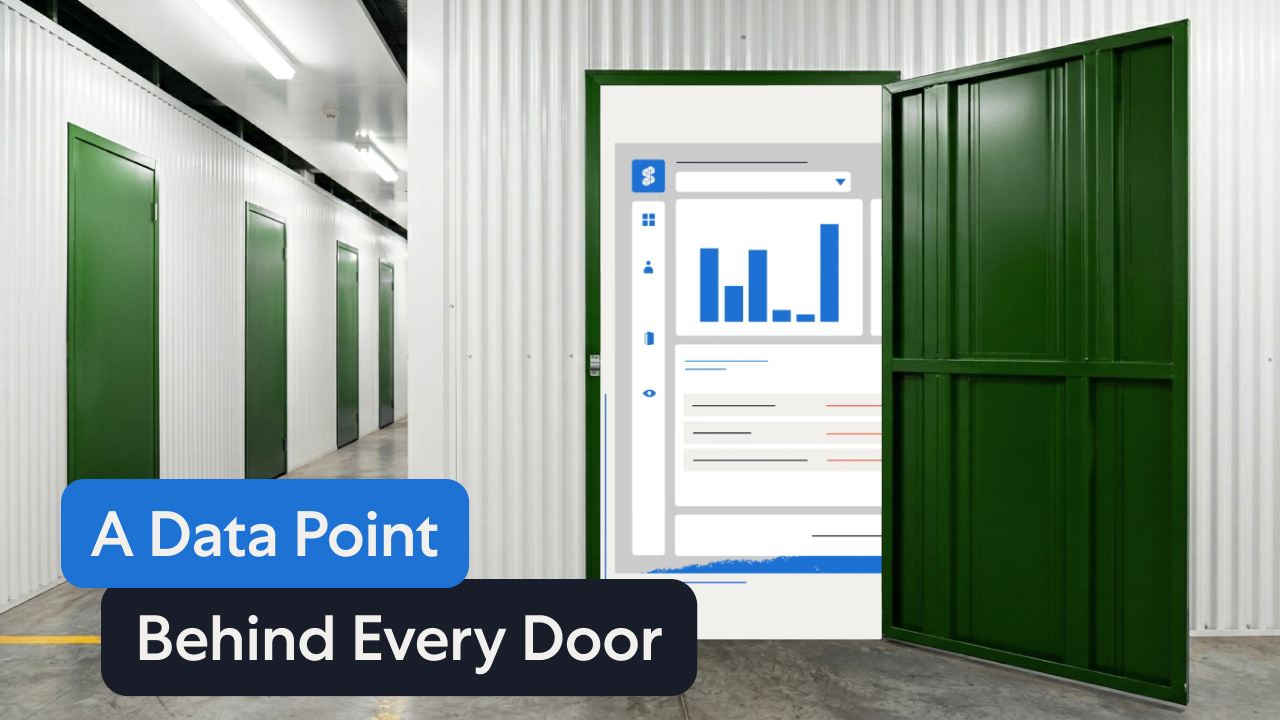
Self-storage used to be straightforward: build the boxes, rent them out, collect payments. For decades, that was enough — low complexity, low staff, low data. That model is no longer sufficient.
A new generation of operators is running facilities that look fundamentally different: digital-first booking, automated move-ins, 24/7 unmanned access, and real-time monitoring across multiple sites. The shift isn’t just operational — it’s a shift in how operators think, from passive landlords to active service providers.
And at the centre of this transformation is a question the old model never had to answer: what is actually happening inside your facility?
Occupancy Tells You a Unit Is Rented. It Doesn’t Tell You Anything Else.
Most operators today still measure performance through the same three lenses: occupancy rate, contract count, and revenue. These metrics aren’t wrong — they’re just incomplete.
A facility showing 85% occupancy looks healthy. But consider:
- What if a third of those “occupied” units haven’t been accessed in six months?
- What if the customers most likely to leave are paid up and quiet — never flagged as at-risk?
- What if evening and weekend demand is far higher than your staffing model assumes?
Traditional metrics show contracts. They don’t show behaviour. Pricing, staffing, marketing, and expansion plans end up built on data that reflects what customers agreed to — not what they actually do.
Scaling makes intuition-based management impossible. As Martin Wild, Co-Founder of Kinnovis and an eight-facility operator himself, puts it:
“A good gut feeling is very important, but definitely it’s not everything. You need to combine it with good data. Without properly structured data, you will never be able to interpret it correctly.”
Why the Shift Is Happening Now
Two forces are converging to make better data unavoidable.
First, the tools exist. Management platforms have matured, smart access systems are deployable at scale, and integration between booking, access control, and payment systems means data is finally connected across the operation.
Second, customer expectations have shifted. Today’s tenant expects to find, book, pay for, and access a unit without speaking to anyone — on a mobile device, at any time of day. Building the infrastructure to serve that expectation generates the data to understand it.
Louise Stokes, who helped grow Swift Storage from one site to 15 in three and a half years before joining Kinnovis, puts it plainly:
“The owners had a lot of assumptions about how a storage facility should operate. With data, we were able to test those assumptions and take out the guesswork. A red flag is when someone says ‘we’ve always done it this way.’ That should always be questioned.”
Access Data: The Most Truthful Signal in the Building
Of all the data a modern storage facility generates, access data is the most valuable — because it reflects customer behaviour most directly. Every time a tenant opens a gate, enters an elevator, or accesses their unit, that interaction is logged: timestamp, door, user. Aggregated across thousands of tenants over months, patterns emerge that no contract data could reveal.
With a traditional padlock, you know a unit is rented. With smart access, you know it’s being used.
What access data actually reveals:
Active vs. inactive tenants. A unit unaccessed for 90 days signals a very different situation from one visited weekly. The inactive tenant may have already mentally left. Identifying them early creates a retention window that wouldn’t otherwise exist.
Usage timing patterns. When do customers actually visit? Evening and weekend access is frequently far higher than operators assume — because the assumption was built without data. Real patterns drive smarter staffing, better security scheduling, and more accurate capacity planning.
Early churn signals. Declining access frequency is a measurable leading indicator of cancellation. Operators who act on that signal — with proactive outreach or a retention offer — recover customers that a reactive model would lose entirely.
“Occupied but unused” units. A unit can appear fully occupied while generating zero actual activity — a blind spot that traditional occupancy metrics hide completely. Identifying these changes how you think about real capacity and pricing strategy.
The Operational Impact: From Cost Centre to Decision Engine
Booking and Conversion
The contact form era is over. 60% of Swift Storage customers booked without ever speaking to a member of staff. 80% of those were on a mobile device.
Martin Wild identifies the most underestimated benefit:
“The major change you’ll experience is suddenly realising how many bookings are coming in outside of opening hours. People want transparent pricing. They want to know exactly what they’re signing up to. And many don’t want to talk to anyone.”
Pricing and Revenue Management
Access data makes dynamic pricing genuinely intelligent. Operators who understand which unit types are accessed most, which customers are at churn risk, and how occupancy fluctuates seasonally can target at-risk tenants with retention offers before they leave — rather than discounting broadly and hoping for the best.
Admin Automation and Staff Focus
When a tenant books online, signs digitally, completes ID verification, and receives access automatically, the administrative workload per move-in approaches zero. Staff time shifts from processing paperwork to serving customers — better for efficiency and for team morale.
Security and Proactive Incident Management
Access logs create a complete audit trail. Combined with remote CCTV monitoring, operators move from reactive security to proactive prevention. An anomalous access pattern at 3am is visible in real time — not discovered the following morning. For multi-site operators, monitoring every location from a single dashboard fundamentally changes the risk profile of unmanned operations.
The Data Maturity Curve: What to Focus on and When
| Stage | Priority |
|---|---|
| First site | Demand understanding — unit sizes, seasonal patterns, local benchmarks |
| Stabilised occupancy | Yield management — pricing, revenue per square metre |
| Portfolio scale | Granular attribution — channel performance, customer lifetime value |
At portfolio scale, marketing budgets run into the tens of thousands. Martin Wild is direct: “You might be wasting a lot of money today without knowing it.” Operators who build data-driven habits early are the ones positioned to scale without hitting the ceiling of operational complexity.
Where AI Is Taking This Next
The volume of data a modern facility generates is already beyond what any team can interpret manually. AI-powered chat and voice tools handle routine enquiries around the clock, in a natural, human-feeling way — so that operators no longer have to choose between after-hours responsiveness and a human touch.
Across reporting, AI surfaces the insights that matter, cutting the time spent extracting conclusions from spreadsheets.
Louise Stokes frames the competitive stakes clearly:
“It’s now possible to pull all your data from all your different sources and make sense of it quickly. If you don’t embrace that, other operators will. That’s when disruption becomes a risk.”
Martin Wild sees a clear endpoint:
“In the future, we will use humans for human contact. All the admin we’re still doing today — all of that is going to be automated. We’ll finally get to where we all want to be: being with people, talking to people.”
The Door Is the Start of Everything
The operators winning in this market are not the biggest or the cheapest — but they are the best informed. Every entry is a data point. Every access log is a signal. Every booking arriving at 11pm on a Sunday is evidence of what today’s storage customer expects.
Sensorberg One Access delivers smart access across every door, gate, and unit — with a full audit trail of every interaction. Integrating directly with leading self-storage management platforms, it connects access data to the systems operators already run, turning every interaction into actionable intelligence.
Listen to the Full Conversation
Hear from Martin Wild and Louise Stokes from Kinnovis about how data is transforming self-storage operations — from occupancy tracking to AI-powered decision-making.